
“I Never Did Anything Alone”: Prof. Stefano Negrini on the King Salman International Award for Disability Research

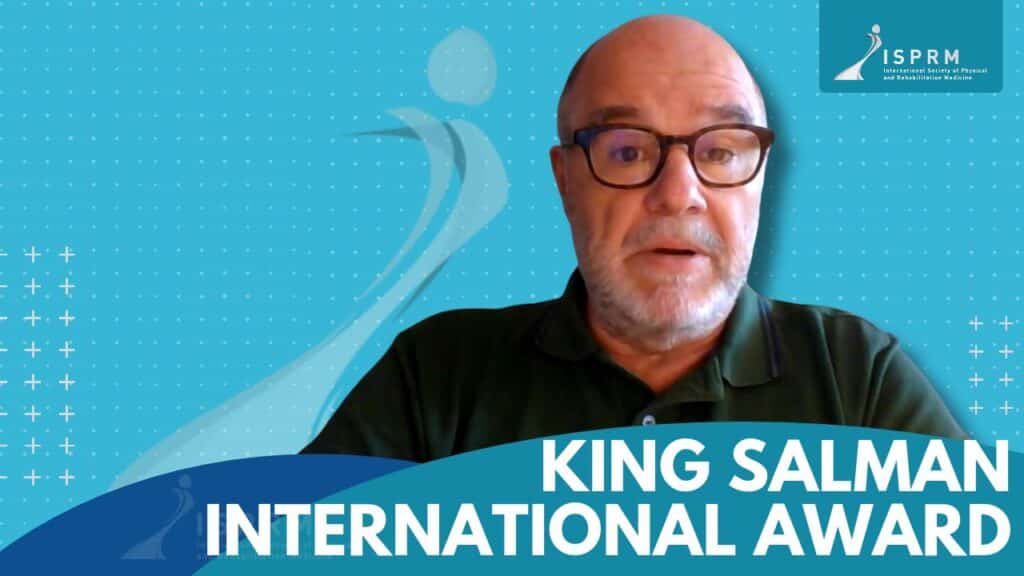
Professor Stefano Negrini has been named joint winner of the fourth edition of the King Salman International Award for Disability Research, in the Rehabilitation and Social Sciences category, together with Professor Christopher Maher (Australia). The award is promoted by the King Salman Center for Disability Research and received 770 nominations from 111 countries in this edition.
Following the announcement, Prof. Negrini spoke with Franchesca König Toro of the ISPRM Communications Committee about what the recognition means and where rehabilitation research should go next.
A recognition shared with teams
Asked what the award means to him, Prof. Negrini pointed first to the people he has worked with. “I never did anything alone,” he said, describing the award as recognition of a life dedicated to research and of the colleagues who made it possible.
He recalled four collective efforts in particular. The first is SOSORT, the international Society on Scoliosis Orthopaedic and Rehabilitation Treatment, which he co-founded. In his words, it helped change the care of children with idiopathic scoliosis from a “wait and see” approach to rehabilitation treatment. The others are ISICO, the Italian Scientific Spine Institute; Cochrane Rehabilitation, now the thematic group Cochrane Rehabilitation, Functioning and Disability; and the European Journal of Physical and Rehabilitation Medicine, which he led as Chief Editor for 18 years before handing over to Prof. Giorgio Ferriero.
Research that serves people
For colleagues starting a research career, his advice was direct: try to make a change, and think of the people we are serving. Research, he said, “can really make a difference if it is helpful”. The compliment he values most came from a colleague who told him his work is always relevant because it helps clinicians do their job better.
The next decade: do better, at lower cost, together
Looking ahead, Prof. Negrini said rehabilitation needs are increasing and the field carries that pressure. In his view, the priority is less about developing new, more expensive technologies and more about delivering what is needed better and at lower cost, so that more people can be reached.
He also called for an end to disputes between rehabilitation professions, citing the World Rehabilitation Alliance as an example of bringing everyone around the same table. “Now is the time to collaborate for the sake of our patients,” he said.
ISPRM congratulates Prof. Negrini on this recognition.
Responses