
Building Momentum: The First 100 Days of ISPRM’s 2026–2028 Presidency

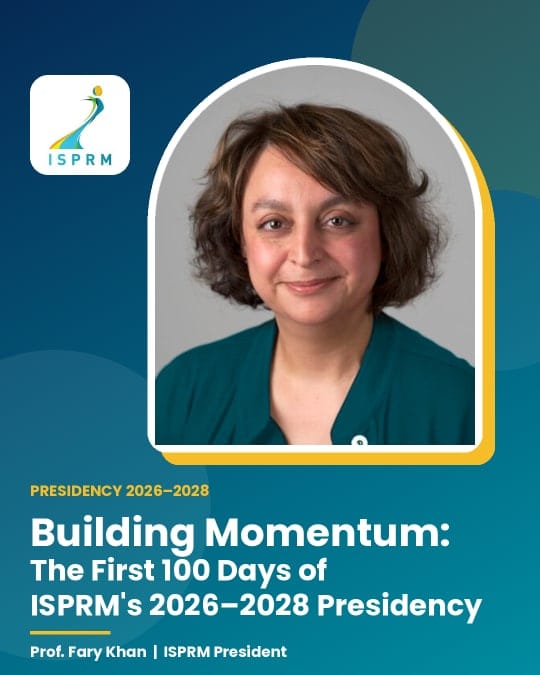
Prof Fary Khan
AM, MBBS, MD, FAFRM (RACP)
ISPRM President 2026-2028
CEO and Medical Director Qatar Rehabilitation Institute Doha
It is with great pride and humility that I present this report marking the first 100 days of our 26-28
Presidents Cabinet term. When I accepted the responsibility of leading the International Society of
Physical and Rehabilitation Medicine, I did so with a clear conviction: that our Society’s greatest strength
lies not in any single person, but in the collective energy of our members, our National Societies, and
our global community of rehabilitation professionals working to expand access to care in every corner of
the world.
These first months have been ones of listening, building, and acting. We have taken a hard look at our
own governance and financial foundations, launching a thorough review of ISPRM’s legal and financial
domicile to ensure our Society is built on a foundation as strong and transparent as the science we
represent. We have worked to formalize the structures — liaisons, task forces, committees — that allow
good ideas to become lasting action.
We have also kept our eyes firmly on the future. Preparations for ISPRM2027 in Bali are well underway,
and I am especially proud of our efforts to ensure this Congress reflects the full diversity of our global
membership — in its speakers, its reviewers, and its scientific program. At the same time, we opened
our doors wider than ever before, offering national societies not yet part of our family the opportunity
to join us at no cost, because our mission is strongest when it is shared broadly.
When crisis struck — as it did with the earthquakes affecting South America and Asia — our Emergency
Response Committee moved quickly, coordinating with local societies and WHO partners to ensure
Rehabilitation Physicians had a seat at the table in acute response efforts. This is precisely the kind of
proactive, member-serving action I hope will come to define this PC’s tenure. None of this happens by
decree. It happens because of the extraordinary members and staff who keep our Society running day to
day.
We are only 100 days in, but the direction is clear: a more transparent, more globally engaged, and
more financially resilient ISPRM — one truly worthy of the patients we ultimately serve. I look forward
to reporting back on our continued progress in the months ahead.
- Leadership & Governance Transition
- New PC took office following the Vancouver elections
- Full walkthrough and clarification of Central Office structure and staffing – first systematic
review of this kind - PC liaison assignments to all committees and SIGs formalized and communicated
- Financial & Legal Reform (Domiciliation)
- Full review launched into ISPRM’s legal/financial “home” (currently Switzerland) — options actively compared
- Domiciliation Task force formed (led by Manoj Sivan) with finance and audit committees to
assess legal, tax and financial implications of relocating - 2026 budget reviewed, anticipated deficit flagged; membership fee restructuring (individual
fees approved for Jan 2027 in Vancouver)
- Membership Growth
- Free 6 months membership (June–Dec 2026) approved for non-member national societies,
aimed at expanding ISPRM’s 61-society base ahead of 2027 paid enrollment
- ISPRM Congresses
- ISPRM2027 (Bali) work in progress
- 2031 Congress bidding process launched
- ISPRM Groups, Committees & SIGs
- New Mentorship Task Force launched
- New International Relations Task Force lauched
- Very active Emergency Response Committee (ERC): active response to
Venezuela/Colombia/Indonesia earthquakes — coordination with WHO/local societies,
advocacy letters to health ministries - New SIGs: Dysphagia and Acquired Brain Injury approved
- ISPRM Academy
- Positioned as “the most academic project in ISPRM history”
- PC motion passed to support Academy funding irrespective of sponsorship availability
- Website/content expansion and future certification pathway under discussion
- Archives of ISPRM (journal)
- New “Global Expert Conversation Series” initiative introduced
- WHO / UN / Global Engagement
- Push for ISPRM to be more proactive rather than reactive with WHO
- Redefinition of WHO and WRA representants
- Africa region engagement flagged as a strategic priority
- Transparency Initiative
- The 100-day report proposed with potential publication in the Archives of Physical Medicine and Rehabilitation
Responses