
The Human Element: Strengthening the Rehabilitation Workforce in Low-Resource Settings

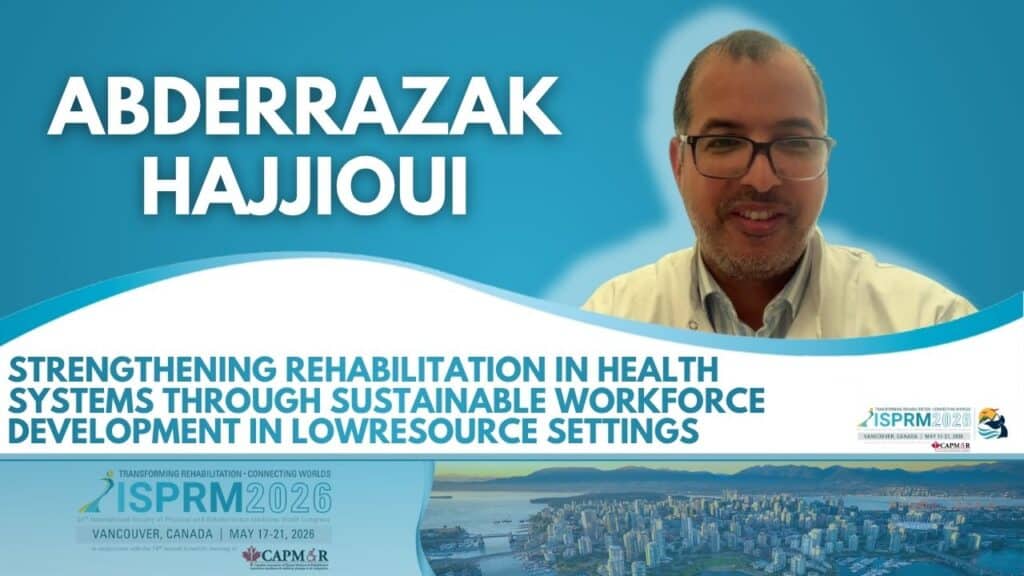
As the ISPRM 2026 conference in Vancouver approaches, global health equity remains at the forefront of the agenda. Dr. Muhammad Tawab Khalil of the ISPRM Communications Committee recently interviewed Professor Abderrazak Hajjioui to discuss his upcoming keynote lecture on strengthening rehabilitation in health systems through sustainable workforce development. Scheduled for Tuesday, May 19th, this lecture will confront one of the most pressing challenges in global healthcare today.
Professor Hajjioui highlighted a staggering reality: while 2.6 billion people globally need rehabilitation, up to ninety percent of these needs are unmet in low-resource settings. He pointed out that many countries heavily invest in infrastructure and technology, yet fail to deliver effective outcomes because rehabilitation is fundamentally people-driven. The true gap lies in the workforce, with some low-income countries having fewer than two professionals per million people. This shortage is compounded by a continuous loss of professionals to migration, brain drain, and burnout.
To combat this, Professor Hajjioui stressed that specialist-driven care alone is not enough, as eighty percent of rehabilitation needs exist in low- and middle-income countries. He proposed a blended approach that combines specialized professionals with trained non-specialized and community-based providers. While acknowledging the importance of task-shifting and digital solutions, he cautioned that they must be integrated into a broader system-wide strategy rather than acting as a replacement for human care. Ultimately, Professor Hajjioui’s message is a call to action: achieving rehabilitation for all requires investing deeply in training, supporting, and retaining the people who deliver the care. Attendees are highly encouraged to join this critical discussion in Vancouver this May.
Responses