
The Cutting Edge of Nerve Transfers: Dr. Michael Berger at ISPRM 2026

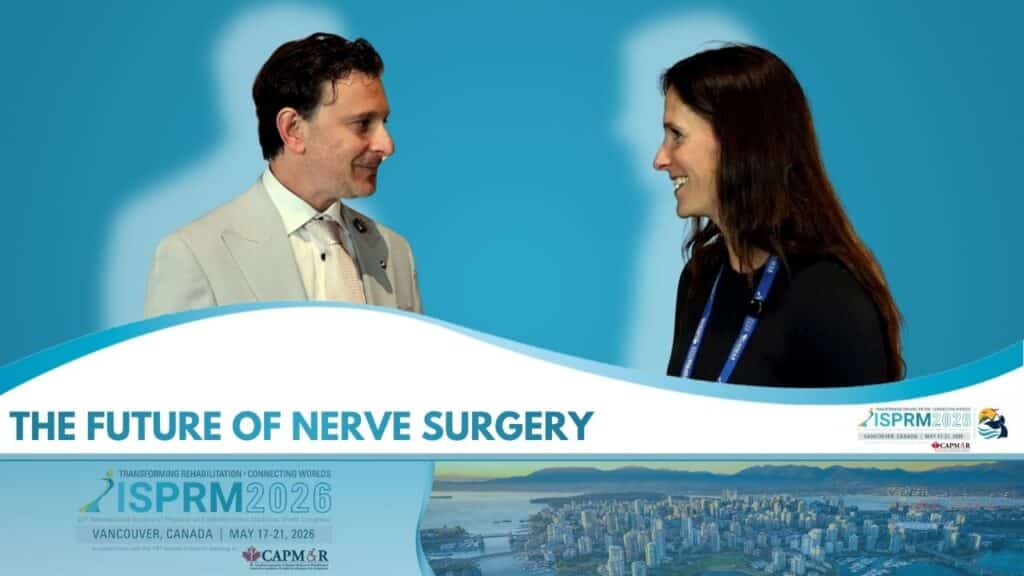
Nerve transfer surgery for patients with spinal cord injuries is a relatively young field, but it is currently standing on the precipice of major clinical breakthroughs. This was the central theme of a compelling interview between Dr. Michael Berger and Franchesca König of the ISPRM Communications Committee, conducted during the International Society of Physical and Rehabilitation Medicine (ISPRM) 2026 World Congress.
Following his comprehensive lecture on the subject, Dr. Berger reflected on the rapid, ongoing evolution of these procedures. He noted that while the fundamental surgical concept is established, the specific clinical application for spinal cord injuries is still developing. «We’ve only been doing it in people with spinal cord injury for 10 or 15 years», Dr. Berger explained. «So it’s actually, that question is a bit hard to answer because we’re just at the cusp of now innovating. And so we now have sort of a 10 to 15 year breadth of experience where we can now say, okay, here’s what works and here’s what doesn’t».
A successful nerve transfer, however, relies just as heavily on meticulous post-operative care as it does on surgical precision. Dr. Berger outlined a rigorous, multiphase rehabilitation protocol. The critical factors for recovery, he stated, are «intensity and repetition, and you have to have somebody in your corner, a champion, either a physiotherapist or an occupational therapist coaching you on specific sets of exercises to do at key times».
He described the rehabilitative progression in distinct, physiological phases. «In the beginning of the rehabilitation phase, you’re not actually going to be able to turn the muscle on that you want to, so it’s about making sure that joints are supple and that range of motion is maintained and that you’re using that sort of donor nerve area and strengthening that area», he detailed. From there, therapists guide patients to activate the target muscle using the donor nerve, before moving to the final, most complex stage. Ultimately, «we switch towards the end of the rehabilitation period to trying to decouple the donor and the recipient so that the action that you intended on in the first place works independently and fluidly». Achieving this level of functional independence, he noted, «takes a village».
Looking toward the next decade, Dr. Berger shared his enthusiasm for a forthcoming clinical trial designed to organically augment these procedures. «I’m really excited for our electrical stimulation trial that we’re just about to launch, so using electrical stimulation intraoperatively to sort of, for lack of a better term, juice up the nerve transfer», he announced. Building on vital foundational data generated by his colleagues at the University of Alberta, Dr. Janna Senger and Dr. Ming Chan, the trial aims to implement this technique as a «cheap, accessible, and safe intervention».
As Dr. Berger highlighted throughout his overarching presentation, the future of nerve transfer surgery hinges on this exact intersection of disciplines. By pairing innovative, intraoperative electrical stimulation with a highly intensive, multidisciplinary rehabilitation framework, physiatrists and surgeons are forging evidence-based pathways to restore profound functional independence and vastly improve the quality of life for patients with spinal cord injuries.
Responses