
The Ambient Horizon: Dr. James Cotton on Integrating AI into Rehabilitation

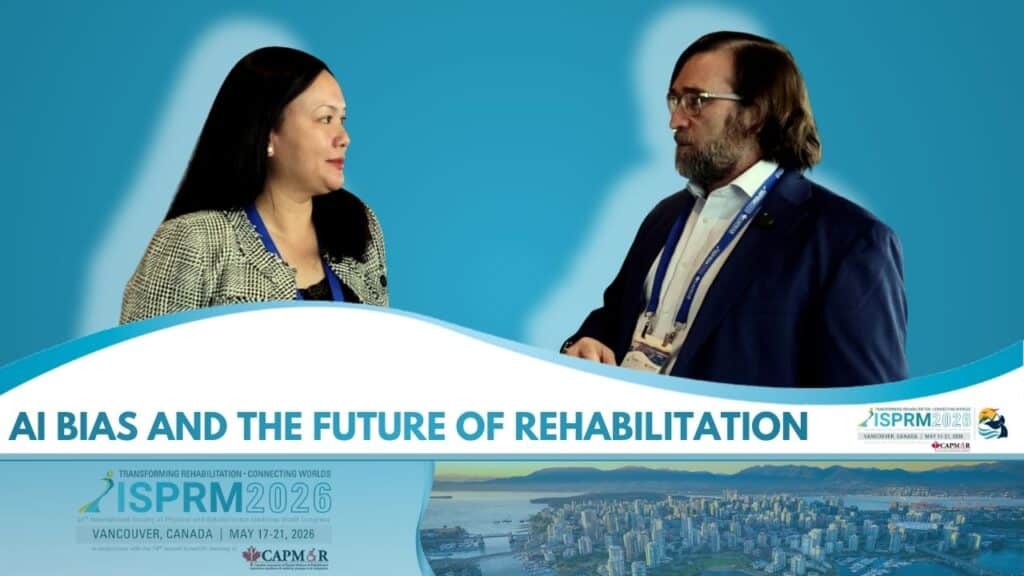
The integration of Artificial Intelligence into physical and rehabilitation medicine is poised to fundamentally alter clinical practice, shifting the field toward rich, big-data analysis and ambient, real-world monitoring. In an exclusive interview with Krystal Song of the ISPRM Communications Committee at the 2026 World Congress, Dr. James Cotton of the Shirley Ryan AbilityLab detailed this technological horizon.
Dr. Cotton emphasized that AI allows researchers to tackle clinical questions that have historically hindered the specialty. Noting that rehabilitation has sometimes struggled to advance quickly through traditional randomized controlled trials alone, he pointed to a data-driven future. “[T]he ability to truly measure much more richly about how people are functioning across levels of the international classification of functioning and take that into big data is going to give us whole new approaches to put forth new hypotheses of how to optimize treatments for people and improve their long-term ability,” Cotton stated.
In the short term, Cotton noted that colleagues are already experiencing AI’s impact through “digital scribes in their clinical practice which can really reduce some of the documentation burden.” However, his primary focus remains on advancing functional assessment: “…where I’m really pushing and the most bullish is just measuring these things that we’ve never been able to measure that are so critical to our patients’ outcomes.”
Realizing this vision requires overcoming substantial hurdles. Beyond the heavy engineering and product development expertise required to deploy computer vision in standard clinics, Cotton highlighted safety-critical issues regarding health equity. He warned that there are “a lot of blind spots in AI as it relates to people with disabilities,” stressing the need to ensure that training datasets and validation methods are “very thoughtful to the clinical populations that we work with.”
Looking five to ten years ahead, Cotton predicts AI will become seamlessly integrated into the physiatric workflow. “I think the practice of rehabilitation medicine will look a lot different because of AI, but we won’t think about it so much. It will just be in the background,” he explained. By utilizing “ambient technology out in the real world,” clinicians will move away from formalized, in-clinic outcome measures and instead base treatments on how patients actually function in their daily environments.
As Dr. Cotton established during his preceding keynote address, the groundwork for this ambient future is already being laid with advanced visual language models like “Biomec GPT” and data-extraction tools like “Therapy LLM.” Ultimately, while AI offers unprecedented capabilities to bridge the gap between bodily impairment and real-world participation, the global rehabilitation community must proactively steer its development to ensure these powerful systems safely, accurately, and equitably serve marginalized populations.
Responses