
Bridging the Resource Gap: Dr. Yudith Chivatá on Low-Cost Prosthetic Solutions at ISPRM 2026

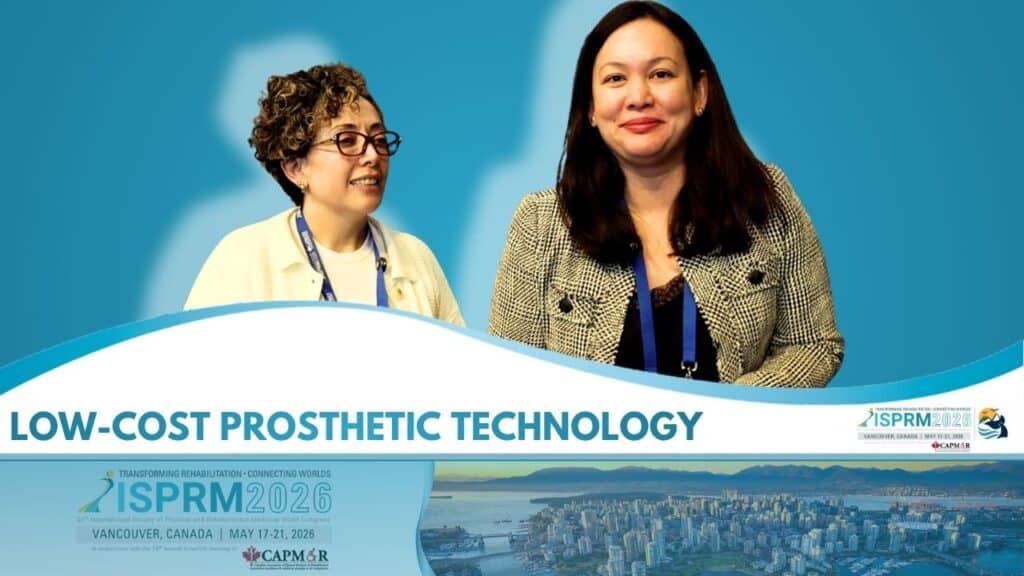
Providing optimal care for patients with amputations requires a delicate balance between advanced medical technology and regional economic realities. This complex clinical challenge was the focal point of an insightful interview with Dr. Yudith Chivatá, a physiatrist from Colombia, conducted by Krystal Song on the opening day of the International Society of Physical and Rehabilitation Medicine (ISPRM) 2026 Congress.
Following her highly anticipated lecture on the subject, Dr. Chivatá outlined the critical strategies required for effectively utilizing low-cost prosthetic technologies in low-resource settings. She emphasized that the foundation of successful rehabilitation begins with an accurate clinical assessment, explicitly stating that practitioners «need to evaluate the K-level in the patient who has an amputation».
The core of her message centered on contextualizing patient care based on available geographic and financial resources. «Use the correct technology in the correct patient. But you need to know what your resources are in your country», Dr. Chivatá explained. She drew a sharp contrast between global healthcare systems, noting the disparity in access to cutting-edge devices. «In my country, I can’t use microprocessor elements because it’s very expensive. But it’s simple if you live in Canada. The context is very different».
For practitioners operating in Latin America and similar environments, Dr. Chivatá detailed practical, low-cost clinical alternatives. She noted that the primary options usually involve pairing mechanical knees with fundamental foot components, such as the SACH foot, the Jaipur foot, or a single axis foot.
Crucially, she warned against the clinical error of mixing disparate technological levels within a single prosthesis. «It’s important that you make the match between the knee to the foot», she stated. «Don’t use high technology in the knee and use low technology in the foot. Why? Because the technology changes the biomechanical comportment if you don’t use the same technology».
By strictly aligning the technological sophistication of the knee and the foot, and carefully matching these components to the patient’s specific K-level and environmental context, physiatrists can maximize functional outcomes despite resource limitations. As Dr. Chivatá concluded in her overarching presentation, deploying the correct, context-appropriate components is the definitive pathway to ensuring the patient recovers their mobility and reclaims their quality of life.
Responses