
Beyond Survival: Dr. Colleen O’Connell on the Role of Rehabilitation in Public Health Emergencies

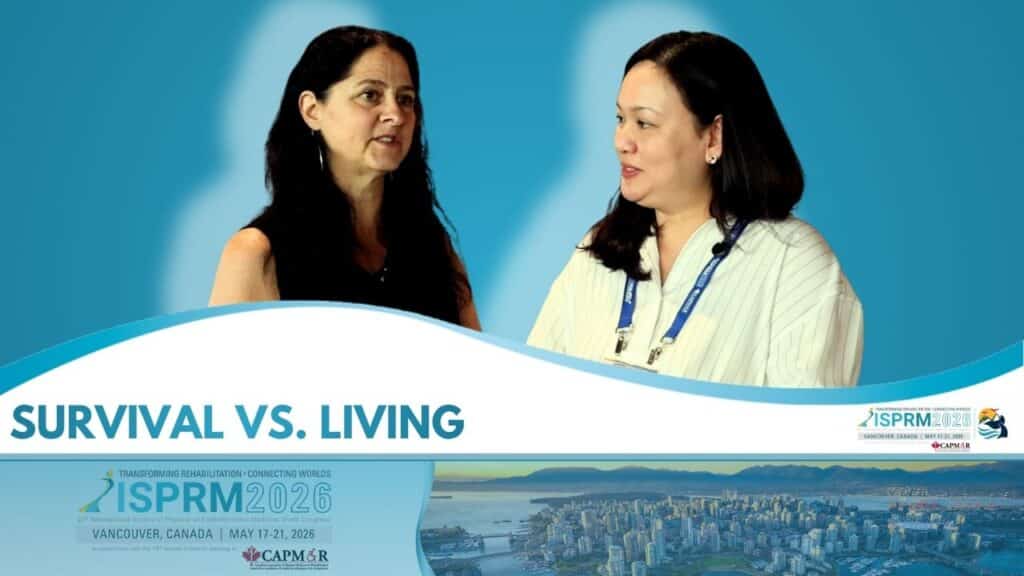
When confronting public health emergencies, the global medical community often prioritizes acute survival. However, physical and rehabilitation medicine provides the essential framework for what comes next: the ability to actually live. This profound distinction was the focal point of an interview with Dr. Colleen O’Connell, conducted by Krystal Song of the ISPRM Communications Committee during the third day of the International Society of Physical and Rehabilitation Medicine (ISPRM) 2026 World Congress.
Following her keynote lecture on the subject, Dr. O’Connell addressed the necessity of shifting how health systems deploy rehabilitation resources. Historically born from the need to manage conflict and polio epidemics, the specialty has frequently been viewed as a post-crisis intervention. Dr. O’Connell argued this reactionary model must end. «[R]ehabilitation must be integrated in cross the entire continuum of the emergencies preparedness, our response, our resilience, as well as in incorporating mitigation strategies», she stated. «We can’t be just the what next, we have to be right there from the beginning».
Drawing upon her extensive background in global health, Dr. O’Connell urged practitioners to recognize that crises are not limited to the traditional, sudden-onset disasters like earthquakes or cyclones. Instead, systemic failures constitute ongoing crises for vulnerable populations. «Emergencies are what people live every day as it pertains to public health», she explained, pointing to domestic housing crises as a prime example. «Who are the most marginalized and the most vulnerable? It’s persons with disability. Who are their best advocates? We as rehabilitation physicians».
Addressing these complex, systemic issues requires the holistic, biopsychosocial approach inherent to physiatry. Dr. O’Connell noted that the practice of rehabilitation is highly adaptable, relying less on complex infrastructure and more on specialized clinical knowledge and the capacity to build patient confidence.
Ultimately, Dr. O’Connell distilled the value of the specialty down to its core humanistic purpose. «Traditional medicine, not rehabilitation medicine, looks at survival. But what is survival without living?» she asked. «And that’s what rehabilitation does is living. And there’s nowhere that that’s more intensely needed than in emergency situations».
As established in her overarching keynote presentation, fostering resilient communities requires acknowledging that global health is not constrained by geopolitical borders. By integrating rehabilitation into the foundational stages of emergency preparedness—whether for a sudden natural disaster or a chronic socioeconomic crisis—practitioners can ensure that patients are not merely kept alive, but are given the functional capacity to reclaim their health, well-being, and humanity.
Responses