
ISPRM establishes a new International Relations Task Force

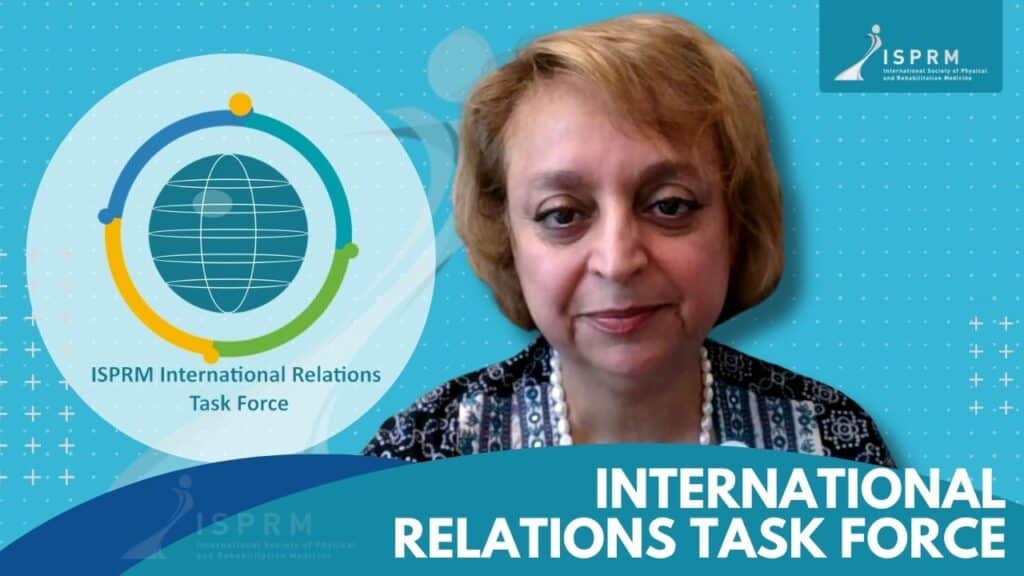
President Fary Khan sets out why ISPRM is consolidating its international work — and how members can take part.
ISPRM has established a new International Relations Task Force, created to coordinate the Society’s engagement with the World Health Organization (WHO), the World Rehabilitation Alliance and the United Nations.
In a message to members, ISPRM President Fary Khan explained the reasoning. As health systems face new pressures worldwide, ISPRM is more active on the international stage than at any point in its history — and, as the President noted, it remains the only society that represents the global community of rehabilitation medicine physicians. That position carries responsibility, and it has generated a volume of work that the Society’s existing structures were not designed to carry.
“We are working really hard with other like-minded societies,” the President said, citing the Asia-Oceanian Society of Physical and Rehabilitation Medicine, the World Federation for NeuroRehabilitation, the Asia-Oceanian Society for Neurorehabilitation, the International Society for Prosthetics and Orthotics, World Physiotherapy and the World Federation of Occupational Therapists. Together, these organizations contribute as international non-governmental organizations to the global rehabilitation agenda, through WHO, the World Rehabilitation Alliance and the United Nations.
Why now
Since taking office three months ago, the President’s Cabinet has reviewed ISPRM’s work agenda alongside its operational and governance activities, to confirm that the Society’s activity is aligned with its mission and with the strategic plan for the next five years. Every committee, Special Interest Group and task force was reviewed; a number of changes were made and new members appointed.
That review coincides with an important moment. ISPRM is entering a new triennial collaborative plan with WHO, developed through the Society’s WHO Liaison Committee — work the President described as a priority for all members, because it shapes how effectively ISPRM can contribute to advocacy, implementation and health policy.
One concrete request has already arrived. WHO has asked ISPRM to help provide information and data for its global status report on rehabilitation — a document the President was careful to distinguish from the global report on disability. Invitations are expected to travel from WHO headquarters to national ministries of health, which may in turn approach national societies for specific information. ISPRM has committed to circulating the WHO survey to all member societies once it is finalised, so that the rehabilitation physician community is well represented in the result.
Other areas of collaboration are also developing, including emergency and disaster rehabilitation — from the deployment of Emergency Medical Teams to the implementation of WHO toolkits and personal preparedness, which the President identified as a significant priority for the Society. A further strand concerns health information and data, including surveys of the rehabilitation workforce and the challenges it faces. The President highlighted three such surveys already completed in the Asia-Oceania region: one by the Rehabilitation Medicine Society of Australia and New Zealand, one led by Japanese colleagues, and one by the research and academic arm of the Asia-Oceanian Society of Physical and Rehabilitation Medicine.
What the task force will do
The task force does not replace or absorb existing work. Representation through the WHO Liaison Committee and in World Rehabilitation Alliance activities continues as before. Its role is to connect, coordinate and facilitate.
Its stated goals are to:
- map and coordinate the activities of existing ISPRM committees relating to WHO, the World Rehabilitation Alliance and the United Nations, so that effort is not duplicated;
- develop a more coherent approach to ISPRM’s relationships with these and other international bodies;
- work more closely with like-minded international non-governmental organizations, for greater collective impact;
- contribute more actively to global rehabilitation policy and its implementation;
- establish clear channels so that international representatives can report back to the task force, the President’s Cabinet and the membership; and
- identify opportunities for members to take part in international work they would not otherwise have the capacity or the opening to join.
Early priorities include mapping existing ISPRM representatives and activities across WHO, the World Rehabilitation Alliance and the United Nations; clarifying roles and reporting lines; giving international work greater visibility through the ISPRM newsletter and, where relevant, Archives of ISPRM; and building a calendar of major international rehabilitation events that members can join, in person or online. The task force is also asked to develop a sustainable model for international advocacy — one that strengthens ISPRM’s influence while respecting that this work is carried out by volunteers.
Governance
The steering committee comprises Professor Walter Frontera, Professor Aydan Oral, Professor Joy Evangelista, Dr Carolina Shiappacasse and Dr Javvad Heider. The President will act as President’s Cabinet liaison during the start-up phase.
Terms run for three years, with a maximum of two consecutive additional terms, consistent with other ISPRM committees and task forces. Responsibilities will be divided within the group according to expertise, regional knowledge and existing roles, so that accountability is clear. The task force will submit an annual report for the ISPRM book of reports, circulate minutes of its meetings within two weeks, and bring proposals requiring President’s Cabinet approval at least 30 days in advance.
The President also announced that Professor Aydan Oral will take on the chair of the WHO Liaison Committee, and thanked the outgoing chair and her team for many years of work on the Society’s behalf.
An invitation to members
Two openings are worth members’ attention.
The ISPRM central office, under Maria Carvalho, recently issued a call for members interested in working on a voluntary basis with WHO headquarters or with the regional offices. Seven or eight members have come forward so far, and the Society will be in contact with them shortly. The call remains relevant for anyone who did not see it.
Separately, Professor Matthew Bartels, who represents ISPRM at the United Nations, has asked for help. UN offices exist in many parts of the world, and he has invited members based near them to nominate themselves — through the task force — to attend regional UN meetings on behalf of the Society.
As the President put it, there are many members who want to contribute more but do not always get the opportunity.
Responses