
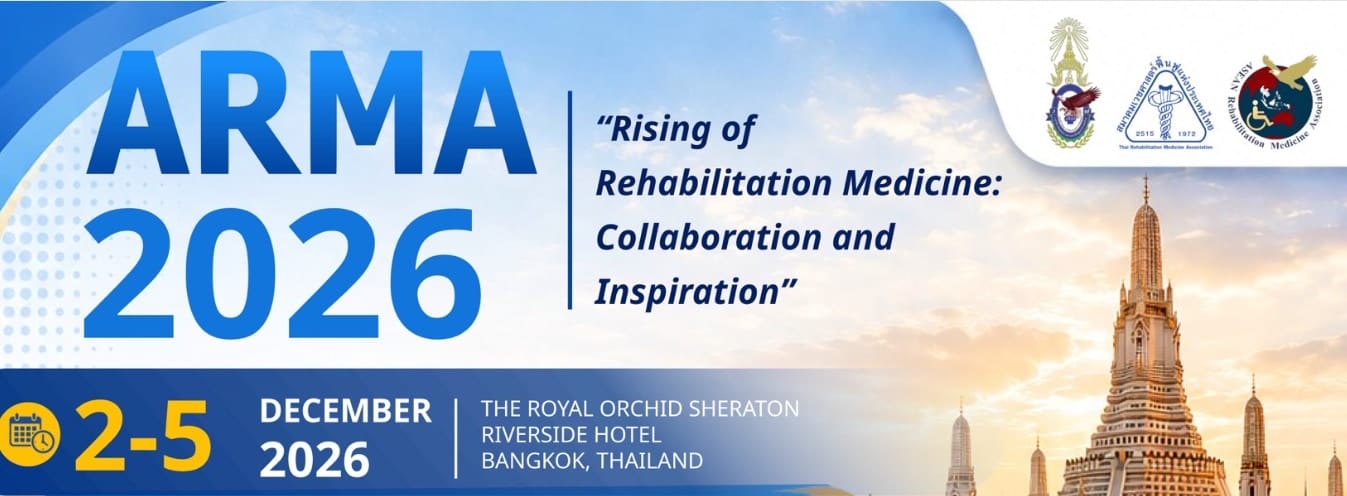
The 11th ASEAN Rehabilitation Medicine Association (ARMA) Congress
The 11th ASEAN Rehabilitation Medicine Association (ARMA) Congress is designed to address the evolving educational and professional needs of physicians, allied rehabilitation professionals, researchers, educators, trainees, and policymakers working in Physical and Rehabilitation Medicine (PRM) and disability management across ASEAN and beyond.
The scientific programme will provide participants with up-to-date evidence, practical clinical knowledge, and emerging innovations across the full spectrum of rehabilitation medicine. Sessions will cover neurological, musculoskeletal, pain, paediatric, geriatric, cancer, cardiopulmonary, spinal cord injury, prosthetics and orthotics, sports rehabilitation, dysphagia, rehabilitation technology, digital health, robotics, artificial intelligence, and regenerative medicine. The programme combines plenary lectures, keynote presentations, expert panel discussions, scientific symposia, oral and poster presentations, hands-on workshops, and live demonstrations to accommodate different learning styles and promote active engagement.
The congress will specifically address the following learning needs:
– Update participants on current evidence, international clinical practice guidelines, and advances in PRM.
Enhance clinical reasoning and practical skills through case-based discussions, interactive workshops, and live demonstrations.
– Promote multidisciplinary and person-centred rehabilitation approaches across different healthcare settings.
Facilitate the translation of research findings into routine clinical practice and health service delivery.
– Showcase emerging technologies and innovations, including robotics, artificial intelligence, digital rehabilitation, and advanced assistive technologies.
– Encourage scientific collaboration, research networking, and knowledge exchange among rehabilitation professionals from ASEAN and the international community.
– Support professional development of early-career physiatrists, rehabilitation trainees, and young investigators through opportunities to present research and interact with international experts.
– Strengthen regional capacity in rehabilitation medicine while supporting the goals of WHO Rehabilitation and the International Society of Physical and Rehabilitation Medicine (ISPRM) to improve access to high-quality rehabilitation services worldwide.
By integrating scientific excellence, practical education, and international collaboration, the congress aims to equip participants with knowledge and skills that can be directly applied to improve patient care, advance rehabilitation services, and strengthen rehabilitation systems throughout the region.


Responses