
People Over Infrastructure: Professor Abderrazak Hajjioui on Global Workforce Development at ISPRM 2026

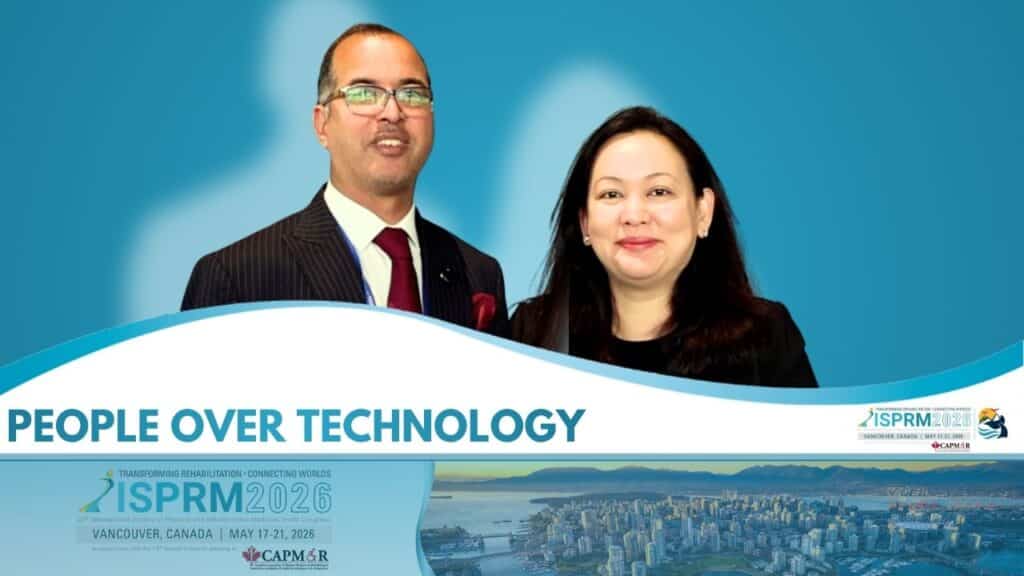
In global health discussions, the advancement of physical and rehabilitation medicine is frequently equated with the acquisition of cutting-edge technology. However, building sustainable care systems—particularly in low-resource settings—requires a fundamental shift in focus from infrastructure to human capital. This paradigm was the central focus of an interview with Professor Abderrazak Hajjioui of Morocco, conducted by Krystal Song of the ISPRM Communications Committee during the second day of the International Society of Physical and Rehabilitation Medicine (ISPRM) 2026 World Congress.
Following his comprehensive keynote lecture on workforce development, Professor Hajjioui addressed common global misconceptions. «[W]hen we talk about rehabilitation, people think that we talk about technology, about infrastructure», he noted. «But the fundamental element is people. With a trained workforce, with a skilled workforce, we can build health system and rehabilitation».
A significant challenge in achieving this goal lies in the global disparity of educational and organizational frameworks. Professor Hajjioui identified a critical systemic flaw: «The main barrier is that we use the workforce models imported from high income countries without adaptation to the national context». He stressed that clinical training and workforce structures must be explicitly adapted to the unique environmental factors and resource realities of their specific regions, rather than assuming imported models will function universally.
To overcome these barriers, Professor Hajjioui outlined a strategic approach centered on robust education and connectivity. «[W]e need to invest in education and leadership because if we have leaders in rehabilitation workforce, we can change the health system», he explained. Furthermore, he emphasized the necessity of cross-regional collaboration among stakeholders, reminding practitioners that «together we are strong and alone we are weak».
Ultimately, as he established in his overarching keynote presentation, realizing sustainable rehabilitation in developing regions demands a complete redefinition of a physician’s responsibilities. «[I]n low resource settings, workforce should work as clinician but also as advocate, as educator, as builder of the health system», Professor Hajjioui concluded. By developing educational models that encompass these broad, global competencies rather than purely technical skills, the international medical community can cultivate the resilient, multifaceted leaders required to transform healthcare delivery worldwide.
Responses