
Precision, Artificial Intelligence, and the Human Element: Professor Nam-Jong Paik on the Future of Neurorehabilitation

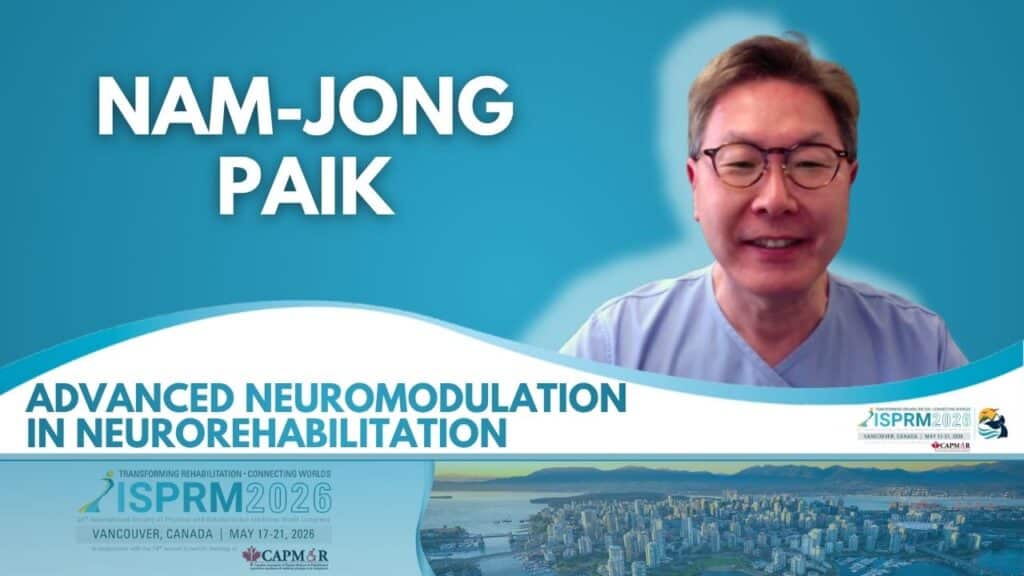
As the global medical community prepares to gather at the ISPRM 2026 World Congress in Vancouver, the conversation surrounding neurorehabilitation is undergoing a profound transformation. Moving away from generalized treatments, the field is stepping into a new era where advanced technology meets deeply individualized patient care. To explore this evolving horizon, Dr. Krystal Song of the ISPRM Communications Committee recently sat down with internationally renowned expert Professor Nam-Jong Paik from the Seoul National University College of Medicine.
Professor Paik, who serves as the incoming President of the World Federation for Neurorehabilitation (WFNR), will deliver a highly anticipated keynote lecture on May 19th focusing on advanced neuromodulation. During his interview, he outlined a compelling vision for the future—one that bridges cutting-edge artificial intelligence with a renewed focus on the unique biological reality of each patient.
The End of “One-Size-Fits-All” Care For decades, standardized protocols have been the backbone of stroke recovery and brain injury rehabilitation. However, Professor Paik emphasizes that because every brain injury is fundamentally unique, our clinical approach must reflect that individuality. The effectiveness of treatments like brain stimulation depends entirely on the structural integrity of the corticospinal tract and the specific network connectivity of the individual patient.
To truly harness and enhance brain plasticity, Professor Paik argues that the medical community must transition to biomarker-driven personalization. In this modern landscape, precision is no longer just an academic goal; it is an absolute necessity for achieving true clinical efficacy and optimizing functional recovery for the patient.
Artificial Intelligence as a Clinical Reality When discussing the integration of intelligent systems—such as closed-loop and brain-state dependent stimulation—Professor Paik offered an optimistic and grounded perspective. The leap toward these futuristic models is closer than many might think.
He highlighted that promising results are already emerging from clinical trials utilizing real-time, EEG-coupled stimulation. While achieving full automation remains an ongoing scientific journey, the rapid integration of artificial intelligence is accelerating the process exponentially. These smart, adaptive systems are expected to transition from research laboratories into everyday clinical reality in the very near future, providing real-time, tailored interventions that adapt to a patient’s immediate neurological state.
Fostering a Global “Virtuous Cycle” Beyond the technology itself, Professor Paik’s vision is deeply rooted in community and global collaboration. As the Chair of the upcoming World Congress for Neurorehabilitation (WCNR) 2026 in Daegu, he is committed to standardizing advanced technologies—the synergy of robotics, virtual reality, and neuromodulation—ensuring that precision rehab becomes accessible to patients worldwide. He looks forward to fostering an even closer bond between the ISPRM and the WFNR to advance the field collectively.
Reflecting on the future of the profession, Professor Paik offered a profound piece of advice for the next generation of clinicians and researchers. He urged young physiatrists not to settle for clinical practice alone, but to maintain a relentless curiosity about underlying neurobiology. By building a framework where research and clinical practice constantly inform one another, the medical community can create a “virtuous cycle”—a mutually reinforcing structure where data drives discovery, and discovery ultimately transforms patient care.
Join the conversation in Vancouver: Professor Nam-Jong Paik will present his keynote lecture on Tuesday, May 19th. The preliminary program for the ISPRM 2026 World Congress is now available, and attendees are encouraged to register to witness the future of precision neurorehabilitation firsthand.
Responses