
Shifting from Disease to Function: Dr. Eleftheria Antoniadou on Aging with Disability

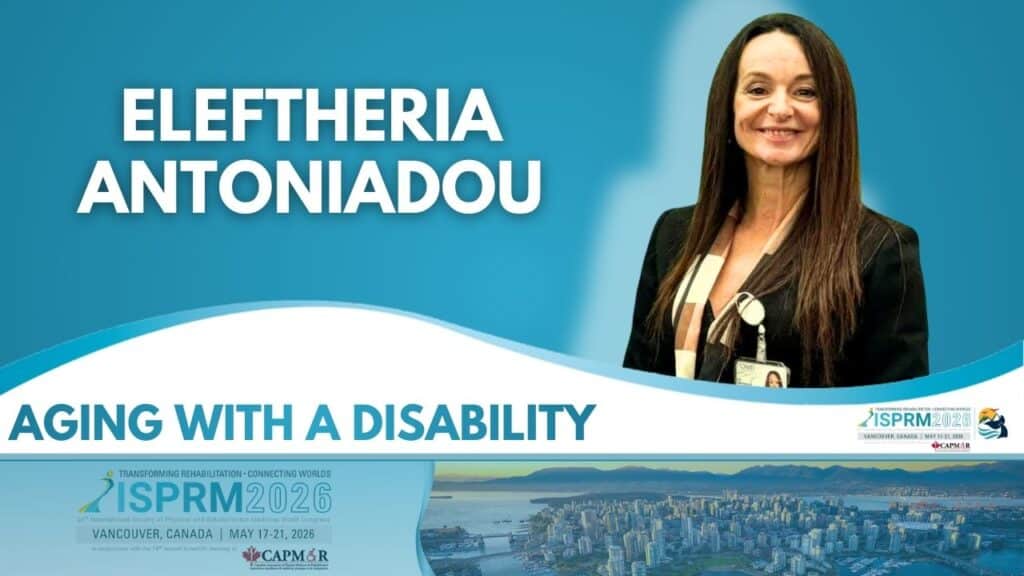
As the ISPRM 2026 World Congress in Vancouver approaches, anticipation is building for a scientific program packed with critical, forward-looking insights. Recently, Dr. Muhammad Tawab Khalil, co-chair of the ISPRM Communications Committee, sat down with keynote speaker Dr. Eleftheria Antoniadou to discuss her upcoming lecture on the intersection of aging and disability. Scheduled for May 20th, her session promises to challenge how global healthcare systems approach a growing demographic of patients.
Dr. Antoniadou notes that as more people live longer with lifelong disabilities, the primary challenge becomes the “accumulation of vulnerability over time”. Individuals who have lived with a disability for decades often reach older age with a much lower physiological reserve. This vulnerability occurs because the natural aging process combines with geriatric syndromes—such as sarcopenia, frailty, and multimorbidity—to accelerate functional declines.
During the interview, Dr. Antoniadou drew a crucial distinction between two different patient journeys: “aging into disability” (where a disability appears later in life via geriatric pathways) and “aging with a disability” (where individuals have been disabled for most of their lives). Although these two trajectories are different, they converge later in life, resulting in highly complex functional needs. The fundamental problem, she explained, is that current healthcare systems are focused primarily on treating disease rather than maintaining function, making them poorly equipped to meet the needs of this special population.
To combat this systemic shortfall, Dr. Antoniadou positions rehabilitation professionals as the “key players”. Because physiatrists and rehabilitation teams focus intrinsically on function, their goal is not merely to treat a medical condition, but to help people move, participate, and remain independent in their daily lives. This ambitious goal requires a lifelong, interdisciplinary approach that supports mobility, prevents avoidable decline, and continuously adapts both environments and care strategies.
Looking ahead, Dr. Antoniadou highlighted three major innovations that give her hope for the future of proactive care:
- AI Technologies: Artificial intelligence will process “big functional data” to detect early declines, allowing for highly personalized rehabilitation protocols while supporting clinical decision-making.
- Digital Health Tools: Wearable sensors, telerehabilitation platforms, and advanced assistive technologies will play a massive role in helping patients maintain their mobility, function, independence, and safety at home.
- Integrated Care Models: There must be a shift away from treating isolated “health episodes” toward a true continuum of care. This proactive model connects prevention, acute medical care, rehabilitation, and community-based support across the lifespan, ensuring the ultimate goal is maintaining long-term function and participation.
Ultimately, these innovations aim to transform our healthcare approach from reactive to proactive, placing function and participation at the very center of patient care. To hear more about this vital transition, attendees are encouraged to catch Dr. Antoniadou’s keynote lecture at ISPRM 2026. The preliminary program is available now, and registration is officially open for the pre-conference workshops taking place on May 16th and 17th.
Responses