
Redefining Technology in Rehabilitation: Dr. Yudith Chivata on Low-Tech Solutions for Amputees

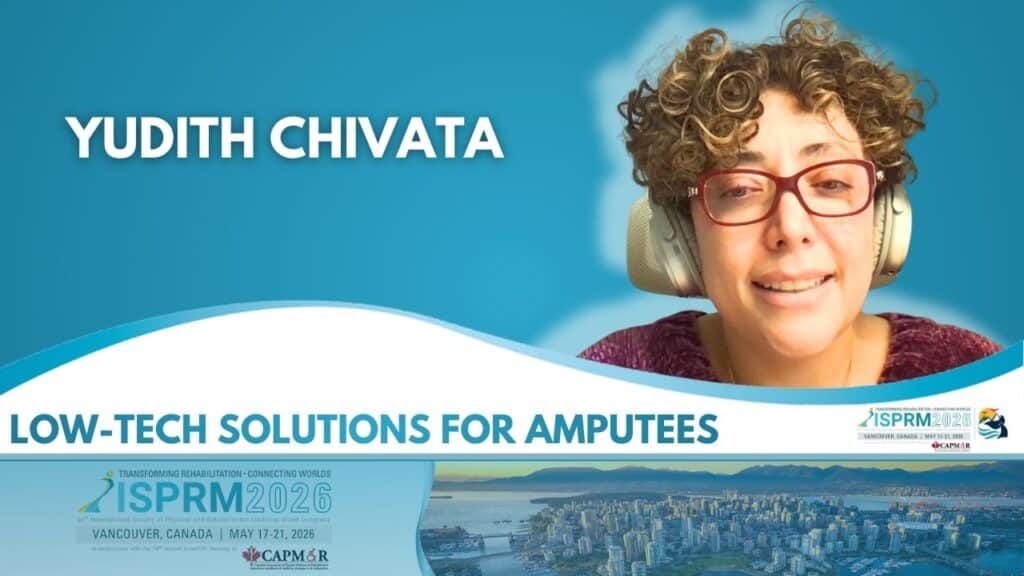
As the global rehabilitation community looks toward the upcoming ISPRM World Congress in Vancouver next May, the scientific program promises to highlight diverse perspectives from around the world. In a recent conversation, Dr. Maria Paz Grisales sat down with Dr. Yudith Chivata, a specialist in Physical Medicine and Rehabilitation and a former professor at the University of El Bosque in Bogotá, Colombia. Known as a regional reference in the field of orthotics and prosthetics, Dr. Chivata will be delivering a keynote lecture that challenges the conventional wisdom regarding technological advancement in patient care.
The core message of Dr. Chivata’s upcoming lecture is both simple and profound: the “best” technology is not necessarily the most advanced or expensive option available on the market. During the interview, she explained to Dr. Grisales that true technological excellence boils down to what works for a specific patient in their unique context. She argues that well-indicated, well-adapted low-tech solutions can often outperform high-tech alternatives, provided they are designed with the patient’s specific functionality and life stage in mind. This approach, she suggests, is crucial for achieving the ultimate goal of physical medicine—reintegrating patients into their social, academic, and professional lives.
To illustrate this, Dr. Chivata offered a compelling example of an elderly amputee who might be prescribed a sophisticated hydraulic polycentric knee. While technologically superior on paper, such a device might instill fear of collapsing in the patient, thereby limiting their mobility. In contrast, a simpler mechanical knee with an extension lock could provide the security the patient needs to walk confidently. This patient-centered “universe,” as Dr. Chivata describes it, must dictate the prescription rather than a rigid adherence to functional classes or catalogs.
Addressing the fascination with robotics and high-tech devices that often dominates medical conferences, Dr. Chivata emphasized the need to return to a focus on functional impact. She noted that while the industry is often dazzled by the “latest motorized knee,” the difficulty lies in navigating this abundance of choices to find the best fit for the individual. She calls for academic training that prioritizes clear functional objectives and rigorous follow-up over mere technological acquisition, ensuring that low-tech and high-tech solutions complement rather than compete with one another.
Finally, Dr. Chivata touched upon the systemic challenges facing low- and middle-income countries, such as fragmented health financing and limited access to early rehabilitation. She advocated for a more integrated approach that unites the entire clinical team—from physiatrists and therapists to the orthotics and prosthetics crew—to break down barriers to care. As she prepares to represent Latin America in Vancouver, Dr. Chivata hopes her lecture will inspire attendees to demystify the world of orthotics and see the patient holistically, fostering a global community dedicated to restoring functionality for amputees.
Responses