
Promoting Musculoskeletal Ultrasound: Prof. Levent Özçakar on the Renaissance in PRM

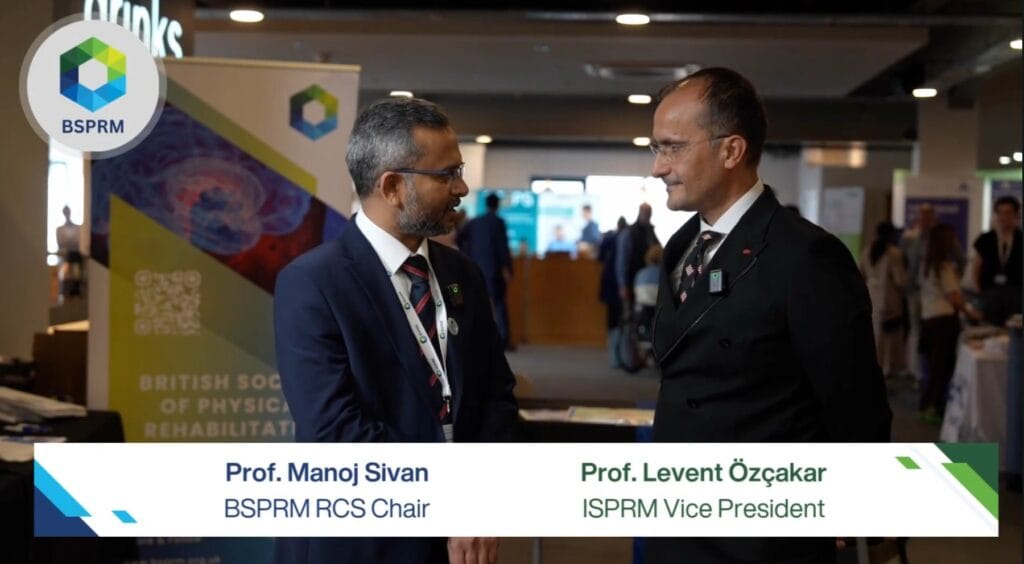
Professor Levent Özçakar, Vice President of the International Society of Physical and Rehabilitation Medicine (ISPRM), recently shared his reflections on the growing role of musculoskeletal (MSK) ultrasound in Physical and Rehabilitation Medicine (PRM), following his participation in the British Society of Physical & Rehabilitation Medicine (BSPRM) annual meeting.
During the interview, Prof. Özçakar expressed his appreciation for the event, saying his first experience with BSPRM “was fantastic” and thanking the organizers “for the great organization.” He noted that while MSK ultrasound “is not that commonly performed in the UK,” his aim was to deliver a clear and encouraging message to colleagues: whether physicians are just beginning to use ultrasound or are already focused on rehabilitation, “you again need ultrasound — and you should start from somewhere.”
A Shift and a Renaissance in the Field
Ultrasound has long been one of Prof. Özçakar’s key passions, and he emphasized how profoundly the technology has reshaped the specialty. “There is definitely a shift,” he said. “The entrance of ultrasound to our specialty was like a renaissance.”
Today, the discussion has evolved into what he calls “the second life after the renaissance,” as physiatrists explore the deeper integration of ultrasound into both diagnostics and treatment planning.
Recognizing the breadth of PRM practice worldwide, Prof. Özçakar acknowledged that “our specialty is quite broad,” and that each department’s needs may vary. His approach, therefore, has been to “simplify different scenarios where ultrasound definitely needs to be used in clinical practice,” helping colleagues at all levels of expertise to implement it effectively.
Advancing Ultrasound Through ISPRM
Looking ahead, Prof. Özçakar intends to use his leadership position within ISPRM to further advance the global adoption of MSK ultrasound. He recalled with humor that the Society has long included an ultrasound-focused special interest group — “we usually say that ISPRM has become ‘US,’ but USGM was actually the special interest group in ISPRM.”
Now, with his increasing role in the organization, he is determined to build on that foundation. “By being in a more political and perhaps stronger position, I might be taking it further,” he said. “I’ll try my best.”
Prof. Özçakar’s commitment reflects a broader vision for ISPRM — one that embraces technological innovation as an essential tool for improving rehabilitation outcomes and strengthening the global impact of the specialty.
Responses